
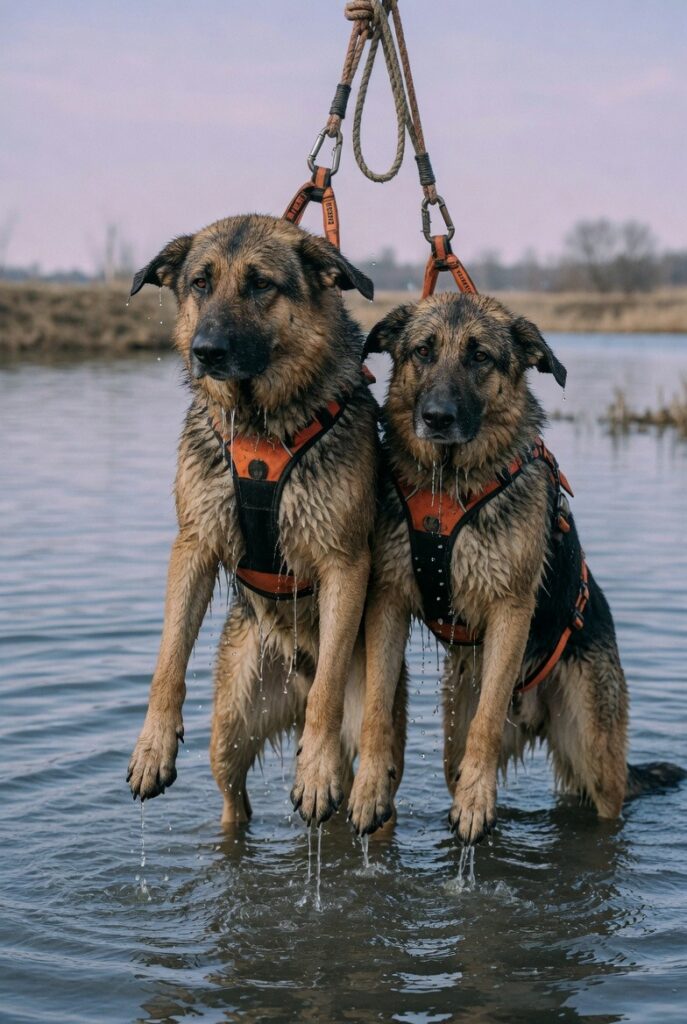
No one listened to the warning of the dog hanging over the river… until the fisherman discovered the secret that someone tried to hide in the fog
Everyone believed that the scene was simply another cruel act abandoned to oblivion, one more of those that occur far from the cameras, but no one imagined that what hung over the river hid something much more disturbing.
Dawn was barely illuminating the surface of the water as Elias’s small boat slowly advanced, cutting through the thick fog that seemed to swallow the sounds, as if the river itself wanted to hide what was about to be revealed.
The ropes hung motionless from the old, rusty structure, swaying with an unsettling gentleness, and at the end of them, the bodies of two dogs appeared lifeless, like a silent warning that no one dared to interpret.
For years, stories like that had circulated in nearby towns, tales of animals abandoned in strange circumstances, but always dismissed as exaggerations or simple acts of cruelty without further explanation or real consequences.
However, something in that scene made Elias not look away, something in the silence, in the tension in the air, in the way the larger dog seemed to resist accepting its inevitable fate.
When the animal opened its eyes, time seemed to stop, and that sound that emerged from its throat was not just any lament, but a desperate signal, a warning directed straight to whoever could understand it.
The fisherman, accustomed to the harshness of life and the tragedies of the river, felt for the first time in years a chill run through his body, a sensation that did not come from fear, but from the certainty that something was not right.
As the boat slowly approached, the dog kept moving, pulling the rope with almost desperate insistence, as if every second counted, as if he knew that time was about to run out.
The other, smaller animal barely reacted, its body hanging weakly, which made the scene even more disturbing, as if it had been placed there not by chance, but with a specific intention.
At that moment, Elias realized that he was not witnessing a simple act of abandonment, but something calculated, something that implied a mind capable of designing suffering with precision and coldness.
When the dog began to direct its gaze toward the upper beam, repeating the movement over and over, the message became impossible to ignore, forcing the fisherman to look where he had previously seen nothing.
At first, he only made out the time-worn structure, the damp ropes, and the fog enveloping every detail, but then something caught his attention, a small lump that moved slightly near the pulley.
That moment marked the point of no return, because what she discovered next would not only change her life, but would ignite a conversation that many would prefer to avoid, an uncomfortable truth that would demand answers.
Climbing the structure was not a brave decision, but an instinctive reaction, driven by the urgency to understand what was happening, while the dog intensified its whimpers as if guiding every movement.
The sack was soaked, tied with a firmness that made it clear it was no accident, and when he finally managed to open it, the contents spilled into his arms, revealing a scene no witness should ever forget.
Two newborn puppies, fragile and trembling, barely breathed, sustained by a chain of events so improbable that it could only be interpreted as a desperate act of survival directed by their mother.
At that moment, everything fell into place in a brutal way, because the big dog wasn’t fighting for itself, but keeping the structure moving, preventing the sack from descending completely into certain death.
The revelation hit hard, not only because of what it meant, but because of what it implied about the person who had designed that situation, someone who not only sought to cause harm, but to prolong suffering in a calculated way.
The older puppy, tied up next to the mother, ceased to be a secondary detail and became a key piece of a macabre puzzle, one that seemed designed to force the mother to witness the agony.
This was not an impulsive act or a product of anger, but a demonstration of conscious cruelty, one that raises uncomfortable questions about how far the human mind can go when it decides to ignore any moral limits.
Why would someone take the time to create such a specific, symbolic scene, so laden with intentional suffering, instead of simply abandoning the animals as happens in so many other cases?
The answer, although difficult to accept, points to a reality that many prefer to ignore, one where the pain of others becomes a spectacle, a message, a way of exerting control even over the most defenseless.
When Elias found the small amulet on the dog’s collar, the story took an even more disturbing turn, because that object did not belong to an animal, but to someone who had been close to her.
The engraved word, “Mara,” opened a new level of mystery, one that connected the scene to a possible human story, to a person, to a past that someone had tried unsuccessfully to erase.
Within hours, news of what happened began to circulate, first among neighbors, then on social media, where the images and stories provoked an immediate, intense, and deeply divided reaction.
Some demanded immediate justice, others doubted the veracity of the events, and there were those who tried to minimize the situation, arguing that such cases occur every day without receiving attention.
But that is precisely why this story cannot be ignored, because it represents something bigger than an isolated incident; it is a reflection of a reality that grows silently.
The internet was flooded with questions, theories, and accusations, generating a wave of debate that crossed borders, even forcing authorities to speak out under public pressure.
Who is Mara, and what was her relationship with the dog found in the river?
Is this an isolated case or part of something larger that has yet to be discovered?
Why had no one noticed any signs of something so disturbing in the area before?
The story ceased to be just about animals and became an uncomfortable mirror, one that reflects collective indifference, the ease with which signs are ignored until it is too late.
While some users called for exemplary punishments, others began to investigate on their own, sharing possible clues, comparing similar cases, and connecting patterns that had previously gone unnoticed.
The pressure grew to the point of making the case a trending topic, generating millions of interactions and forcing traditional media to cover what initially seemed like an isolated incident of no importance.
Elias, for his part, never sought attention, but his testimony became the axis of a story that no longer belonged to him, but to all those who decided not to look the other way.
The most unsettling thing is not just what happened that morning, but the possibility that it wasn’t the first time, nor the last, and that there are similar stories waiting to be discovered.
Because if this case made anything clear, it’s that sometimes the warnings are there, visible, audible, desperate, but only a few are willing to stop long enough to understand them.
And when someone finally does it, as happened with Elias, there is no way to ignore what comes next, because the truth, however uncomfortable it may be, always finds a way to surface.
The question now is not what happened in the river, but what we are willing to do to ensure that it does not happen again, and that answer inevitably involves all of us.
Leave a Reply