
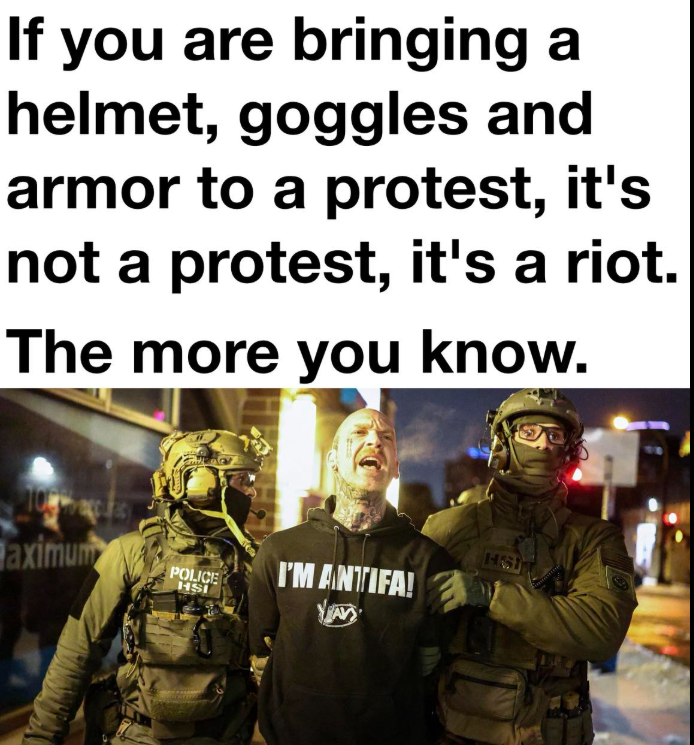
A viral image shared across major social media platforms has reignited a fierce national conversation regarding the nature of modern civil unrest and the shifting boundaries of public demonstrations (image_d9cadc.png). The commentary accompanying the image addresses a highly controversial aspect of street activism, stating: “If you are bringing a helmet, goggles and armor to a protest, it’s not a protest, it’s a riot.”
The viral post features a high-intensity photograph of tactical law enforcement officers detaining an individual sporting a sweatshirt emblazoned with the words “I’M ANTIFA!” (image_d9cadc.png). The stark contrast between the heavily geared participants on both sides has brought a critical question to the forefront: Does arriving at a demonstration prepared for physical combat change the legal and ethical definition of the event?
The Argument for Intent and Escalation
For many critics of aggressive street activism, the inclusion of tactical gear like helmets, eye protection, and protective padding is clear evidence of an expectation—or even an intent—to engage in violent conflict.
Legal experts and law enforcement proponents often argue that standard peaceful assemblies rely on public visibility and open dialogue to deliver a message. When groups arrive in uniform or donning protective combat apparel, it is frequently interpreted by municipal authorities as a sign that the gathering is prepared to resist police commands, block traffic illegally, or engage in property damage. Under many local jurisdictions, a protest officially transitions into a “riot” or “unlawful assembly” the moment clear threats of violence or destruction to property materialize.
The Counter-Argument for Self-Defense
Conversely, activist groups and civil liberties advocates offer a completely different perspective on the utilization of protective equipment. They maintain that wearing helmets and goggles has become a necessary safety measure for peaceful demonstrators navigating increasingly militarized crowd-control responses.
Supporters of this view point out that law enforcement agencies frequently utilize tear gas, pepper spray, rubber bullets, and batons to disperse crowds. From this standpoint, bringing defensive gear is not an indicator of aggressive intent, but rather a practical precaution to safeguard one’s physical health while exercising the constitutional right to protest.
A Fragmented Public Square
As the image continues to gather thousands of comments, shares, and reactions online, it highlights a deep societal fragmentation over public safety and civil rights. The debate is no longer just about the political message behind a demonstration, but also about the optics and physical preparations of the individuals occupying the streets.
With municipal governments across the country continuously reviewing their guidelines on assembly permits and police intervention thresholds, the question of what constitutes a peaceful protest versus an active riot remains one of the most volatile topics in contemporary political discourse.
Where do you draw the line between a prepared protest and a riot? Does bringing protective gear automatically signal violent intent to you? Let us know your thoughts in the comments below, and please share this article to broaden the discussion.
Leave a Reply