
A Silent Barn and an Empty Stall
For Montana rancher Jim Miller, the silence was the hardest part. Usually, his prize mare, Belle, was the first to greet him with a soft nicker. But after a traumatic miscarriage, the spark in her eyes had vanished. For three agonizing days, Belle paced the perimeter of the pasture, her cries echoing against the mountains. She refused to eat, refused to sleep, and most tellingly, refused to step foot near the barn.
On the morning of the fourth day, the pasture gate was found nudged open. Belle was gone.
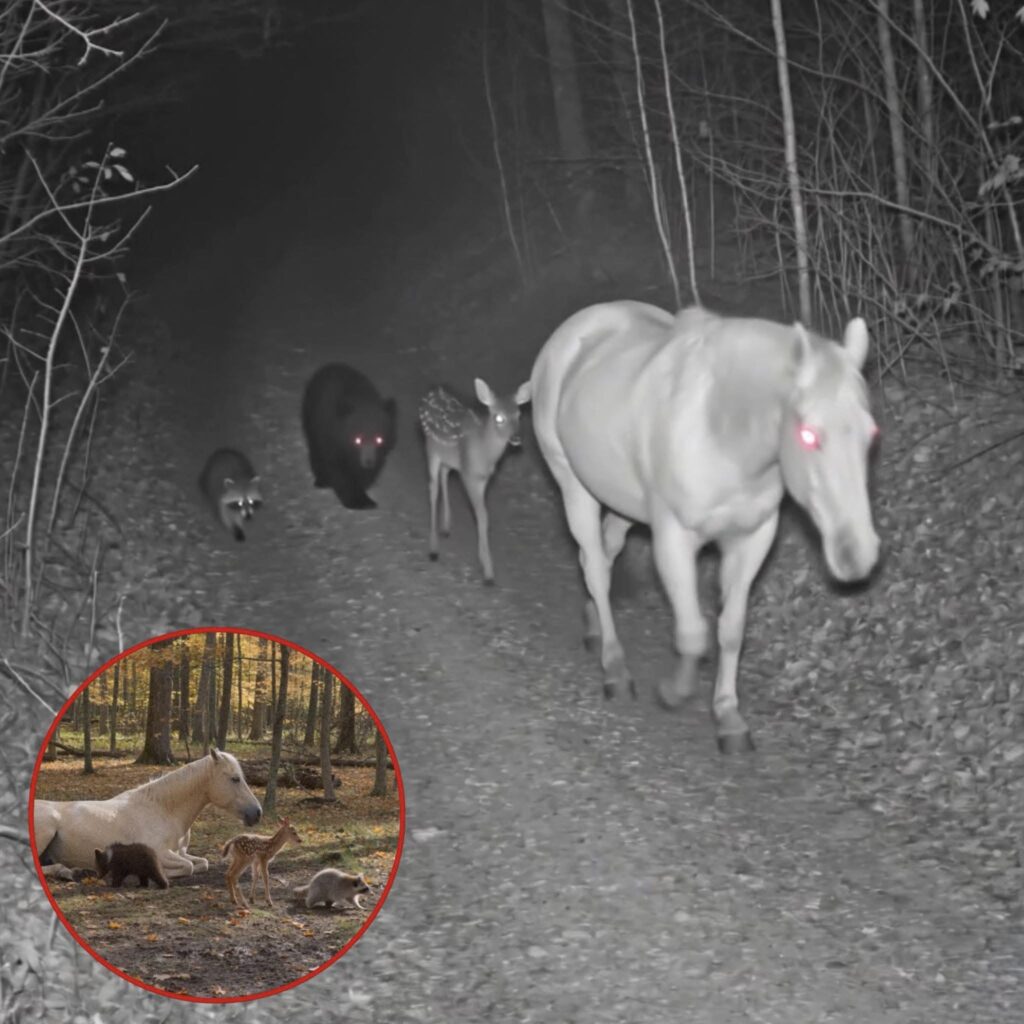
The “Ghost Horse” of the Bitterroot Range
Search parties turned up nothing. As weeks turned into a month, Jim feared the worst—predators or the harsh terrain. Then, a local news segment caught his eye: “Mystery Mare Leading Forest Orphans.”
Wildlife biologists had been monitoring trail cameras and noticed a bizarre phenomenon. A lone chestnut horse was appearing in different locations, but she wasn’t alone.
• The First Sighting: Standing guard over a trembling, lost fawn during a thunderstorm.
• The Second Sighting: Two tiny fox kits trotting confidently beside her hooves as she moved through a clearing.
• The Third Sighting: Nuzzling a stray calf that had wandered away from a neighboring ranch.
Experts were baffled by the interspecies “nanny” behavior until Jim recognized the distinctive white blaze on the mare’s forehead.
The Discovery in the Meadow
Following the trail camera coordinates, Jim and a team of rescuers trekked deep into a secluded valley. They found her in a golden meadow, but she wasn’t running.
Belle was lying down, her Great Heart finally still. Curled tightly against her legs was a young fawn, fast asleep. The mare wasn’t just wandering; she had been patrolling. She had turned her grief into a search mission, seeking out every motherless soul in the woods to provide the warmth she had prepared for her own foal.
“Love Left to Give”
The reunion was quiet and tearful. As Belle leaned her head against Jim’s shoulder, the rescuers realized that the mare hadn’t suffered a breakdown—she had experienced a breakthrough.
“I thought she ran away because she was broken,” Jim said, watching as the fawn was safely transitioned to a wildlife rehabilitator. “But I was wrong. She ran because she still had love left to give, and she wasn’t going to let it go to waste.”
Leave a Reply